


Adinizing Unlocks the Regenerative Power of Fat
Fat is more than volume—it’s the body’s richest reservoir of stromal cells, extracellular matrix (ECM), and paracrine signaling factors that drive tissue repair and rejuvenation.
By mechanically preserving these stromal elements and signaling capabilities—without enzymes or chemical alteration—the Adinizer transforms structural fat into a potent autologous bio-stimulator that supports tissue renewal and healing from within.
From aesthetic rejuvenation to wound care, orthobiologics, and intimate wellness, Adinizing empowers physicians to harness the full biologic potential of the patient’s own tissue for targeted regenerative treatments.
Efficient Processing & Structural Consistency
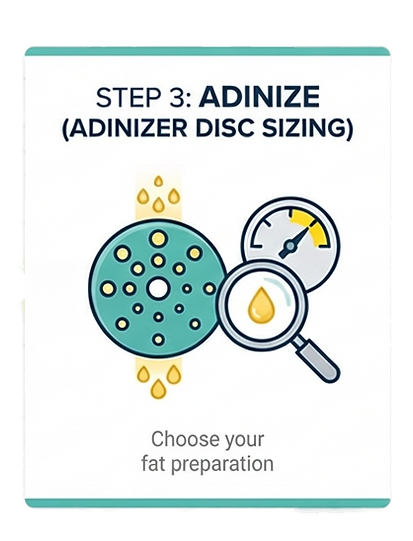
The Adinizer shears fat into uniform, size-controlled grafts in just 3–5 low-pressure passes. Its multi-disc, blade-cutting design provides complete control over graft size—matching each preparation to the preferred cannula or needle gauge based on anatomical depth or clinical indication.
From structural micro-fat (11G–23G) to regenerative nano-fat and stromal tissue concentrate (25G–30G), every pass preserves cell viability and extracellular integrity. The result: predictable graft architecture, optimized biologic potency, and efficient, reproducible outcomes.
The Adipose Spectrum
Adipose tissue exists along a functional spectrum—from larger, structurally supportive fat used for volume and
contouring to finely processed, cell-rich fractions ideal for regenerative applications. Each level of refinement offers
distinct biological and clinical advantages, enabling surgeons to tailor grafts to the needs of the procedure and the
patient. With precise, size-controlled processing, the Adinizer allows you to move seamlessly across this spectrum.
Regenerative Fat

Structural Fat

Why Clinicians
are Switching
The Adinizer uses interchangeable, size-specific blade discs
that shear adipose across a large cutting surface area.
Clinicians experience:
Lower destructive pressure
vs narrow-path, high-force transfers
More consistent particle sizing
through disc-defined outputs
More predictable handling
at the intended deliverability target
Adinizer's closed, standardized pathway helps reduce variability across operators and cases, giving practices:
Less open handling and fewer transfers
More consistent preparation workflow across team members
Easier staff training around repeatable preparation steps
Clearer linkage between disc pathway, preparation type, and deliverability target